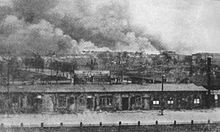
On the 19 April 1943 the Warsaw Ghetto Uprising began. After years of systematic persecution, starvation, beatings, torture, isolation and round ups, what was left of the Jews of Warsaw were to be either deported to camps or destroyed on the spot by the Nazi SS. For those Jews who were young and strong enough, those two options were not going to be accepted.
The Warsaw Ghetto had been established in November 1940, part of the ghettoization process that the Germans had introduced across Eastern Europe following the Nazi occupation. The invasion of Poland and Eastern Europe had presented the Nazis with large populations which they wished to contain before destroying. The containment helped to ensure that the community could be drained of any possible resources before the next stage of removal. The conditions in the ghettos also meant that the Jewish population would be physically and morally destroyed in large numbers without violent intervention by the SS themselves. Indeed thousands of Jews died through malnutrition and disease.
From 1942 the Nazis began a series of ‘Aktions’ in the Ghettos – that is they would carry out mass call ups and deport those called up to resettlement camps however they were in fact the now established Death Camps.
It did not take long for news of what was happening at the camps to reach some of the underground political organisations in the Ghettos.
From the very start of the occupation and the establishment of the Ghettos the Jewish inhabitants had begun to resist the Nazis. They had continued to pray, to educate each other, to meet in groups and had refused to simply accept that they would be eradicated. Emanuel Ringlebaum established the Oneg Shabbat archive to record life and the conditions for future historians and Rabbis carried out Bar Mitzvahs and weddings.
Some of the younger people of the ghetto, people without family, former members of Zionist and sporting youth groups, those who had simply had enough and had nothing to lose, started to form other forms of resistance groups.
In Warsaw the Jewish Combat Organisation (ZOB) was formed from the left wing groups and they were led by Mordechai Ancielwicz and Marck Edelman. The Jewish Military Union (ZZW) was formed by the right wing groups and was led by Sawid Maryc Apfelbaum . Both groups and their membership were committed to armed resistance. They tried to steal weapons where they could, and following contact with other Polish resistance groups they had weapons smuggled into them. Of course, the reality was that none of the resistance groups had any real access to arsenals after three and half years of German occupation. So, when the Polish Home Army in Warsaw transferred all their weapon stocks to the Ghetto resistance it meant a great deal. Therefore, with a stockpile of smuggled and homemade weaponry the Warsaw armed resistance was planned.
The Nazis planned their attack on the ghetto for the eve of Passover, believing that the remaining Jews there would be distracted and taken by surprise, and while some were, others were ready.
The ZOB and ZZW led resistance was ferocious and tenacious, making the Nazis realise that they could not just brush these people quickly aside. Instead of a day to destroy the remnants of the Jewish Warsaw Ghetto the resistors were still holding out and creating casualties amongst the SS. The head of the SS Police in Warsaw was dismissed from his post due to the humiliation and a new even more brutal commander appointed.
The resistance created strongholds that held up the SS advance, creating bottlenecks that destroyed their machinery and equipment.
Apfelbaum was killed in one of the major battles in Muranowski Square along with most of the ZZW, though a few managed to get out to the forest using specially prepared tunnels and escape plans, to join other groups.
The new SS Brigadefuhrer Jurgen Stroop rejected suggestions to bombard the Ghetto from the air and sent in even more brutal SS contingents. On the 8 May the Nazis discovered the ZOB main headquarters at Milla 18 Street. Rather than be captured many of the leaders and fighters who were in the bunker committed suicide using cynadide, including Ancielwitz
On 10 May,a Bundist member of the exiled Polish Government in London, killed himself as a protest against the Allied Governments for their lack of support to the Polish Jews in Warsaw. Szmul Zygielboim said in his suicide note:
I cannot continue to live and to be silent while the remnants of Polish Jewry, whose representative I am, are being murdered. My comrades in the Warsaw Ghetto fell with arms in their hands in the last heroic battle. I was not permitted to fall like them, together with them, but I belong with them, to their mass grave. By my death, I wish to give expression to my most profound protest against the inaction in which the world watches and permits the destruction of the Jewish people.
Despite this the Allies did nothing and what was left of the fighters continued to hold out until the 16 May when the Uprising was officially ended. With the destruction of the Great Synagogue of Warsaw. Edelman and a handful of the remaining ZOB fighters got out via the sewers to other resistance groups.
By the end,the Jewish Ghetto of Warsaw had been reduced almost entirely to rubble, with practically no buildings remaining. The number of German causalities was in the hundreds though the exact figures as stated by the Germans have repeatedly been questioned. However, regardless of the numbers of dead and injured the Jewish resistors had demonstrated that the Nazi machine was not all powerful. It had been held up by a few thousand poorly armed starving Jewish youth. The moral victory was firmly in the hands of the resistors. The signal they sent out to other Jewish resistance groups and non-Jewish resistance groups was immense.
It must be acknowledged that not everyone was able to resist in this way and that those who resisted in non-armed ways also showed incredible courage and bravery. However, the events of the Warsaw Ghetto Uprising also serve to show that when physical resistance was possible there were many who were able to carry out that possibility. The memory is a blessing as well as an inspiration.